
For many professionals, a career in corporate America follows a familiar path.
You work hard. You take on more responsibility. You lead teams, hit goals, solve problems, sit through plenty of meetings, and keep moving toward the next promotion.
Then, somewhere along the way, you start asking a different question:
What if I put all this experience toward building something of my own?
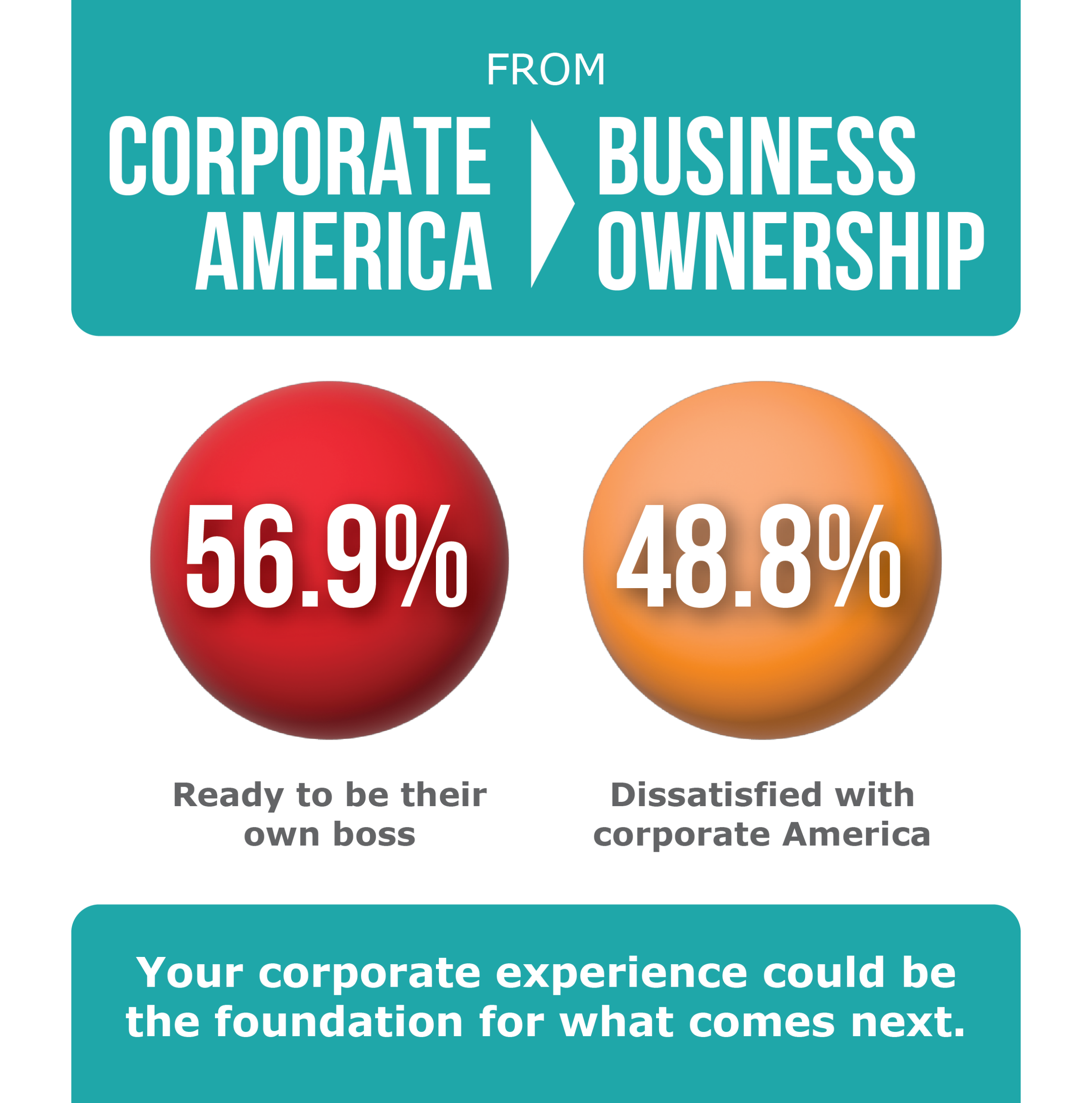
More professionals are asking that question. According to Guidant Financial’s 2026 Small Business Trends report, 56.9% of surveyed small business owners said they were motivated by the desire to be their own boss. Another 48.8% pointed to dissatisfaction with corporate America.
For some experienced professionals, franchise ownership offers a path from corporate leadership to business ownership without starting completely from scratch.
You Already Have More Experience Than You Think
One of the biggest misconceptions about becoming a franchise owner is that you need experience in the specific industry you are entering.
In reality, many of the skills developed during a corporate career translate directly into business ownership.
Think about what you already do every day:
- Lead and motivate a team
- Manage a budget
- Build relationships
- Solve problems
- Set goals and track results
- Manage competing priorities
- Make decisions when things do not go according to plan
- Sell an idea, product, or service
- Hold yourself and others accountable
Those are not just corporate skills. They are business ownership skills.
For City Wide Facility Solutions franchise owners, experience in facility services is not the most important part of the equation. The model is built for business leaders who know how to sell, lead people, build relationships, and grow an organization.
Wanting More Control Over Your Career
There are plenty of benefits to a corporate career. But after years of working within someone else’s structure, some professionals start looking for more control over what comes next.
That could mean more control over their schedule, their income potential, the team they build, or the direction of the business.
It could also mean wanting their hard work to build something they own.
That desire for independence is not unusual. Guidant Financial’s research found that becoming your own boss remains the top motivation among the small business owners it surveyed.
Business ownership does not mean less work or less responsibility. In many ways, it means more.
The difference is where that work is going.
Instead of putting your experience toward someone else’s business, you are putting it toward building an asset of your own.
Starting a Business Does Not Have to Mean Starting From Scratch
The idea of owning a business sounds exciting. However, building every process, system, technology platform, marketing plan, and sales strategy from the ground up is the part that often sounds less appealing.
Franchising offers another route.
Franchise owners operate their own businesses while working within an established brand and business model.
And franchising represents a significant part of the U.S. economy. The International Franchise Association’s 2026 Franchising Economic Outlook projects approximately 845,000 franchise establishments operating in the U.S. in 2026, supporting nearly 8.9 million jobs and generating more than $921 billion in economic output.
Commercial and residential services are also projected to be among the fastest-growing franchise sectors in 2026, with year-over-year growth of 3.2%, according to the report.
With City Wide, franchise owners step into a B2B model built around recurring client relationships and a wide range of facility services. Owners focus on building relationships, developing their teams, creating new business opportunities, and growing their operation.
They are using many of the same skills that helped them succeed in corporate America, but this time, they are using those skills to build their own business.
Your Corporate Experience Is Not Something You Leave Behind
Moving from corporate America to business ownership does not mean starting your career over.
It means taking what you have already learned and applying it in a new way.
Years spent managing people, developing client relationships, meeting revenue goals, navigating challenges, and making business decisions have value outside of a corporate environment.
In fact, today’s small business owners often come to entrepreneurship with years of professional experience behind them. Guidant Financial’s 2025 research found that Gen X represented 49% of the small business owners surveyed, the largest generational group in its study.
For the right person, years spent in corporate America create a strong foundation for the next chapter.
The title might change from vice president, director, manager, or sales leader to business owner.
But the skills that got you there come with you.
Is Business Ownership Your Next Move?
Leaving a corporate career is a big decision, and franchise ownership is not the right fit for everyone.
But if you have reached the point where you want more control over your future, more opportunity to build long-term value, and the chance to put your leadership experience toward something of your own, it might be worth exploring.
You do not have to know everything about facility services. You do need to know how to lead, build relationships, solve problems, and grow a business.
Those are skills many corporate professionals have spent their entire careers developing.