
Anyone researching franchise opportunities will likely encounter the term Item 19. It is one of the most discussed sections of a Franchise Disclosure Document (FDD), and for good reason.
Most prospective franchise owners want a straightforward answer to a simple question:
What is the financial potential of this business?
Item 19 is the closest thing to that answer. However, it is also one of the most misunderstood sections of the franchise buying process.
Understanding what Item 19 means, what it does not mean, and how it should be evaluated can help prospective franchisees make more informed decisions.
What Is Item 19?
Item 19 of a Franchise Disclosure Document contains what is known as a Financial Performance Representation (FPR). This section allows franchisors to disclose information about the financial performance of existing franchise locations, including revenue, gross profit, or other financial metrics.
While Item 19 is often one of the most anticipated sections of an FDD, franchisors are not required to provide this information. However, if a franchisor chooses to share financial performance data, the information must be supported by written documentation and based on actual results, according to the Federal Trade Commission (FTC).
Because Item 19 is the only section of the FDD where franchisors can legally discuss financial performance, many franchise buyers view it as one of the most important parts of the franchise evaluation process.
Why Item 19 Matters
Evaluating a franchise involves more than selecting a recognizable brand. It requires assessing the long-term viability and financial potential of a business model.
Item 19 can provide valuable insight into questions such as:
- How much revenue do franchise locations generate?
- How do newer locations compare to mature locations?
- What do top-performing franchisees achieve?
- What does average system performance look like?
- How much do results vary from one franchise location to another?
The FTC encourages prospective franchisees to carefully review financial performance representations and verify information through conversations with existing franchisees and professional advisors.
While Item 19 cannot predict the future performance of any individual owner, it can provide meaningful context for evaluating an opportunity and identifying questions that deserve further exploration.
The Biggest Misconception About Item 19
One of the most common misunderstandings is the belief that Item 19 serves as a guarantee.
It does not.
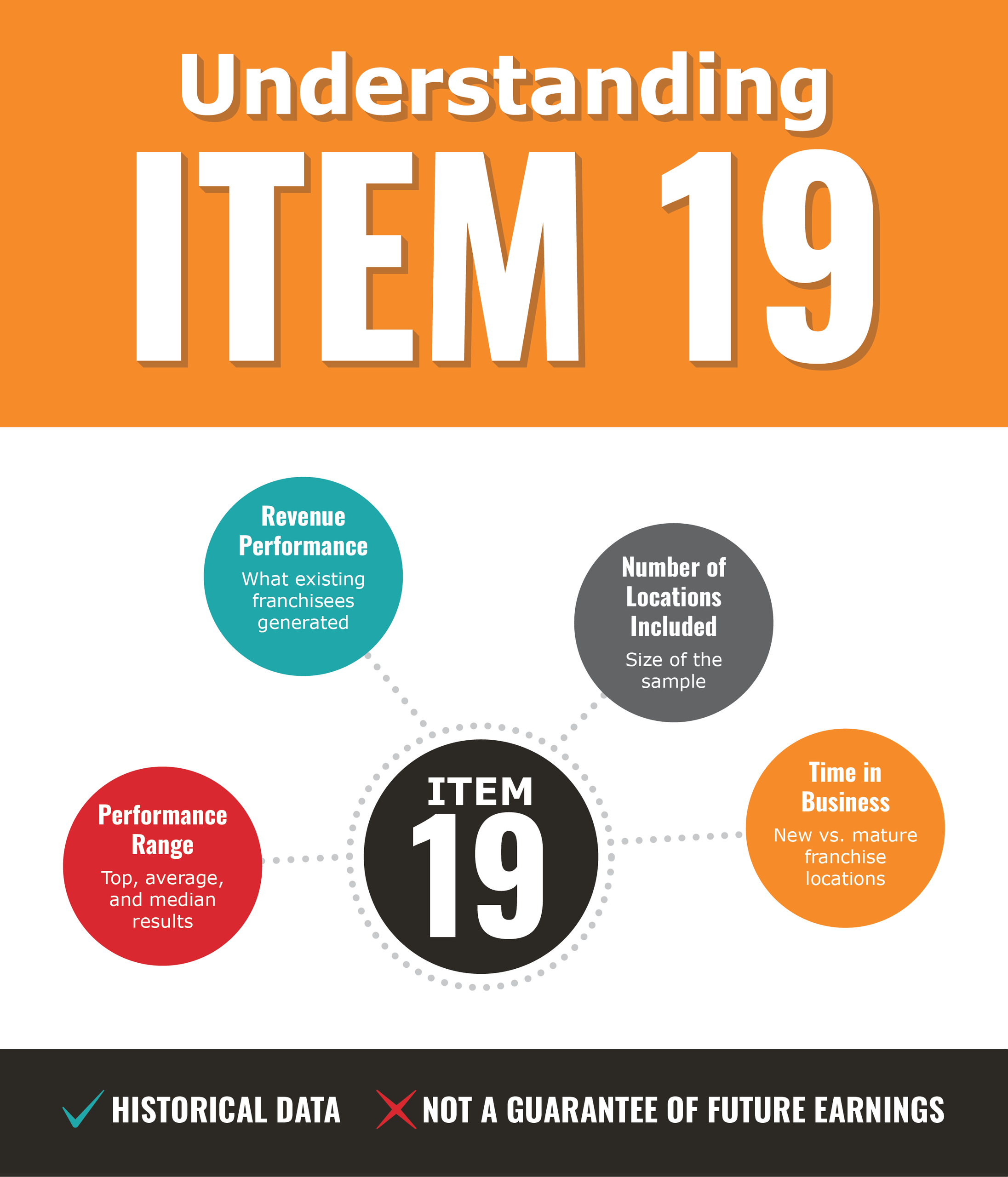
Item 19 reflects historical results achieved by existing franchise locations under specific circumstances. It is not a promise of future earnings or business performance.
Individual results may vary based on factors including:
- Leadership and management capabilities
- Business development efforts
- Hiring and retention decisions
- Market demand
- Competitive conditions
- Operational execution
The FTC requires franchisors that provide financial performance information to explain the basis for those claims and disclose that actual results may differ.
For that reason, Item 19 should be viewed as a due diligence tool rather than a financial forecast.
What Should Prospective Franchisees Look for in Item 19?
Not all Item 19 disclosures provide the same level of detail, but it should answer the following questions.
How Many Locations Are Included?
A disclosure based on hundreds of franchise locations generally provides more context than one based on a small sample size.
Are Results Reported as Averages or Medians?
Average performance can be heavily influenced by a handful of top-performing locations. Median performance often provides a clearer picture of what a typical franchisee may experience.
How Long Have the Locations Been Operating?
A first-year location will often perform differently than a mature location that has been operating for several years. Understanding the age of the businesses included in the disclosure provides important context.
Are Expenses Included?
Revenue is only part of the story. Some franchisors also disclose gross profit or other performance metrics that help paint a more complete financial picture.
Is There Context Behind the Numbers?
Strong Item 19 disclosures explain how data was collected, which locations were included, and any assumptions or limitations associated with the information.
How Item 19 Fits into the Bigger Picture
Financial performance is an important part of evaluating a franchise opportunity, but it doesn’t tell the whole story.
A thorough franchise evaluation should also consider factors such as the business model, support system, market demand, owner responsibilities, and opportunities for long-term growth.
For example, a franchise with strong recurring revenue offers greater stability and predictability than one that relies heavily on one-time sales. Understanding how the business generates revenue, retains customers, and supports franchisees can provide valuable context when reviewing Item 19 data.
It’s also important to understand what franchise ownership looks like on a day-to-day basis. Financial results are often influenced by factors such as business development efforts, relationship management, operational execution, and leadership. Looking beyond the numbers can help prospective franchisees better understand what drives performance across the system.
When viewed alongside other aspects of the franchise opportunity, Item 19 becomes a much more valuable tool for evaluating whether a business aligns with an individual’s goals, experience, and expectations.
Questions to Ask Beyond Item 19
Item 19 should be viewed as one component of a broader due diligence process.
Prospective franchisees may want to ask:
- What characteristics do the most successful franchisees share?
- How long does it typically take to build a client base?
- What business development support is available?
- What level of owner involvement is expected?
- How do mature franchisees compare to newer operators?
- What percentage of revenue is recurring?
Answers to these questions often provide context that financial disclosures alone cannot provide.
Additional resources such as Can You Own a Franchise Without Industry Experience? and Is Franchise Ownership Right for You? can also help prospective owners evaluate franchise ownership from multiple angles.
The Bottom Line
Item 19 is one of the most valuable sections of a Franchise Disclosure Document because it provides insight into how existing franchisees have performed. However, experienced franchise buyers understand that financial performance data is only part of the story.
The most effective franchise evaluations consider the complete picture: financial performance, owner responsibilities, support systems, recurring revenue opportunities, and long-term growth potential.
When viewed in the proper context, Item 19 can help prospective franchise owners ask better questions, conduct more thorough research, and make more informed investment decisions.