When people first hear “facility solutions franchise,” it is easy to picture the owner out in the field managing cleaning crews, fixing maintenance issues, or personally overseeing every service call.
That is not how the City Wide Facility Solutions model works.
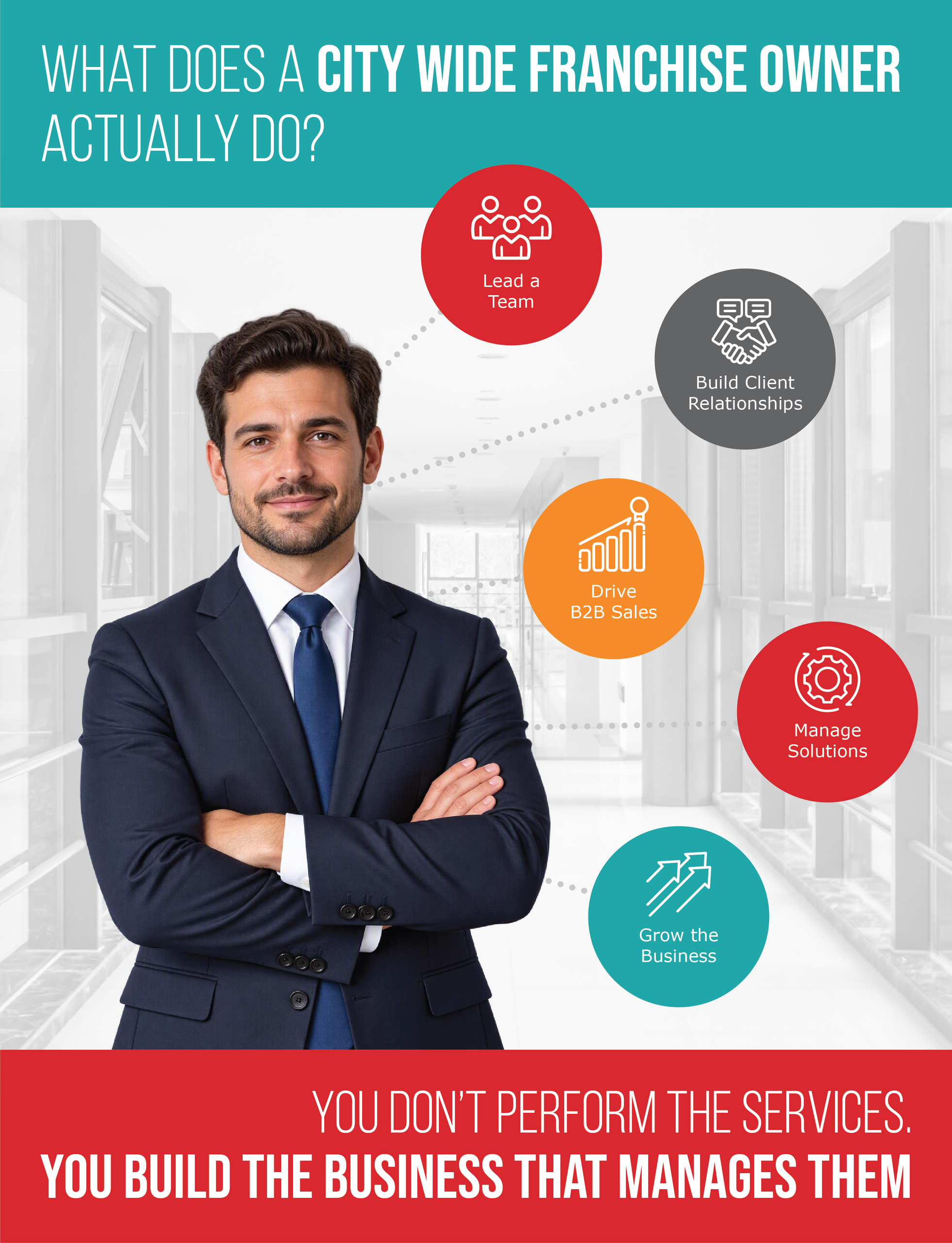
A City Wide franchise owner’s role looks much more like that of a CEO. They build a team, develop client relationships, drive sales, make strategic decisions, and create a business that is designed to grow beyond what one person can manage on their own.
So, what does a City Wide franchise owner actually do every day?
They Lead the Business
At its core, City Wide is a B2B sales and management business.
Franchise owners are responsible for the direction of their local operation. That includes setting goals, reviewing performance, developing their team, making hiring decisions, managing financial performance, and deciding where the business needs to go next.
That leadership role matters.
The U.S. Bureau of Labor Statistics (BLS) projects approximately 308,700 openings for general and operations managers each year from 2024 through 2034. The skills BLS identifies as important for these leaders include leadership, problem-solving, decision-making, and adaptability.
Those are also skills that translate well to the role of a City Wide franchise owner.
You do not have to know how to perform every facility service. You need to know how to lead people, make decisions, solve problems, and build a business.
They Build Relationships and Drive Sales
Sales is a major part of the City Wide model, especially as an owner builds the business.
City Wide works with commercial clients rather than individual consumers. Owners and their sales teams develop relationships with decision-makers such as facility managers, property managers, building owners, and business leaders.
That means prospecting, networking, meeting with potential clients, understanding their facility challenges, and showing them how City Wide simplifies those responsibilities.
There is a reason City Wide looks for owners with strong B2B sales, leadership, and business backgrounds.
Sales leadership continues to be valuable across the U.S. economy. BLS projects employment for sales managers to grow about 5% from 2024 to 2034, with approximately 49,000 openings each year over that period.
But selling at City Wide is not simply about closing one transaction. The goal is to build long-term business relationships.
According to City Wide’s 2026 Item 19 FDD data, the average client relationship lasts approximately eight years.
That changes the conversation from “What can I sell today?” to “How can we continue helping this client over time?”
They Manage the Solution and They Don’t Have to Perform the Service
This is probably the biggest misconception about the business.
City Wide manages more than 20 interior and exterior facility solutions, but the franchise owner is not expected to personally provide those services.
Instead, City Wide works with a network of independent service contractors who have the people, equipment, and expertise to complete the work. The City Wide team manages the client relationship, coordinates the appropriate solution, oversees service quality, and helps solve problems when they arise.
Think of the owner as the person building and leading the organization behind the solution.
If a client needs janitorial services, landscaping, floor care, parking lot maintenance, window washing, or another facility service, the owner’s job is not to become an expert technician in each of those areas.
The owner’s job is to build a team and system capable of getting the right solution for the client.
They Grow Existing Client Relationships
Winning new business is important, but growth does not stop once a client signs a contract. Commercial buildings have a long list of ongoing needs.
A client that initially works with City Wide for janitorial services will eventually need additional support with floor care, landscaping, HVAC, parking lot services, handyman services, window washing, or other facility needs.
That gives owners two ways to grow: develop new client relationships and expand the services provided to existing clients.
It is one of the reasons relationship-building is so important in this business.
Instead of constantly starting over with a new customer, owners and their teams have the opportunity to become a trusted resource for clients over time.
They Build a Team Instead of Trying to Do Everything Themselves
In the early stages of almost any business, an owner wears a lot of hats.
But the goal with City Wide is not for the owner to keep every one of those hats forever.
As the business grows, franchise owners build teams around them. Sales professionals focus on new business. Account management and operations team members help support clients and coordinate services. Leadership responsibilities begin to spread across an organization instead of remaining with one person.
That is an important distinction for someone comparing franchise opportunities.
City Wide’s model is designed to scale.
According to City Wide‘s current franchise information, the average franchise generates $9.8 million in annual revenue, while franchise locations in the top quartile average $24.35 million annually. These numbers represent historical performance and are not a guarantee of future results, but they help demonstrate the size of organizations the model has supported.
City Wide also reported 17.4% growth when announcing its recognition in Entrepreneur’s 2026 Franchise 500, where the brand ranked No. 126, up from No. 143 the previous year.
Building a business at that scale requires more than an owner who works hard. It requires an owner who knows how to build and lead a team.
They Keep an Eye on the Bigger Picture
One of the most important parts of ownership is also one of the hardest to put on a daily checklist.
Owners have to think ahead.
Where is the next growth opportunity? Who needs to be added to the team? Which client relationships have room to grow? Where is the business performing well? Where does it need attention?
Those questions become increasingly important as the organization grows.
And there is plenty happening within the facility management industry itself. BLS projects employment for administrative services and facilities managers to grow 5% from 2025 to 2035, faster than the average for all occupations, with approximately 36,100 openings each year. BLS points to continued attention on building efficiency and environmental standards as one factor supporting demand.
Facilities are not becoming simpler to manage. For many organizations, they are becoming more complex.
City Wide owners build businesses around helping clients manage that complexity.
So, What Might a Typical Day Look Like?
There really is no single “typical” day for a business owner.
One morning might start with a leadership meeting to review sales numbers and client activity. From there, an owner could meet with a prospective client, coach a salesperson, review financial results, talk through a client issue with an account manager, interview a potential new employee, and finish the day looking at goals for the next quarter.
The important part is what is not on that list.
The owner is not expected to personally clean the office, repair the HVAC system, stripe the parking lot, or perform every other service City Wide manages.
Their job is to lead the people and processes that make those solutions happen.
Is That the Kind of Owner You Want to Be?
Not every franchise model asks the same thing from its owner.
Some are built around an owner working directly in the business every day. Others are designed around managing a small team or operating a storefront.
City Wide is different.
The model is built for someone who wants to lead a team, develop B2B relationships, drive sales, solve problems, and build an organization.
City Wide has been in business since 1961 and franchising since 2001, giving franchise owners an established system to follow while they build their local business. Today, the network includes more than 100 locations across the United States and Canada.
For professionals coming from corporate sales, management, operations, or leadership roles, that distinction is worth considering.
You may be changing what you own without completely changing what you are good at.
Because becoming a City Wide franchise owner is not about learning how to do 20 different facility services.
It is about learning how to build a business that manages them.