Choosing a franchise involves more than finding a recognizable brand or an industry with room for growth. The business model matters just as much.
How does the business generate revenue? What role does the owner play? Who performs the day-to-day services? What systems are already in place? And what does growth look like beyond the first few years?
These questions help explain what makes City Wide Facility Solutions different from many other franchise opportunities.
It’s a B2B Business
City Wide operates in the commercial facility services industry, helping businesses manage the services they need to keep their facilities running.
Instead of selling directly to consumers, City Wide franchise owners build relationships with businesses in their local markets. Clients span a wide range of industries and facility types, including offices, industrial facilities, healthcare, education, retail, and more.
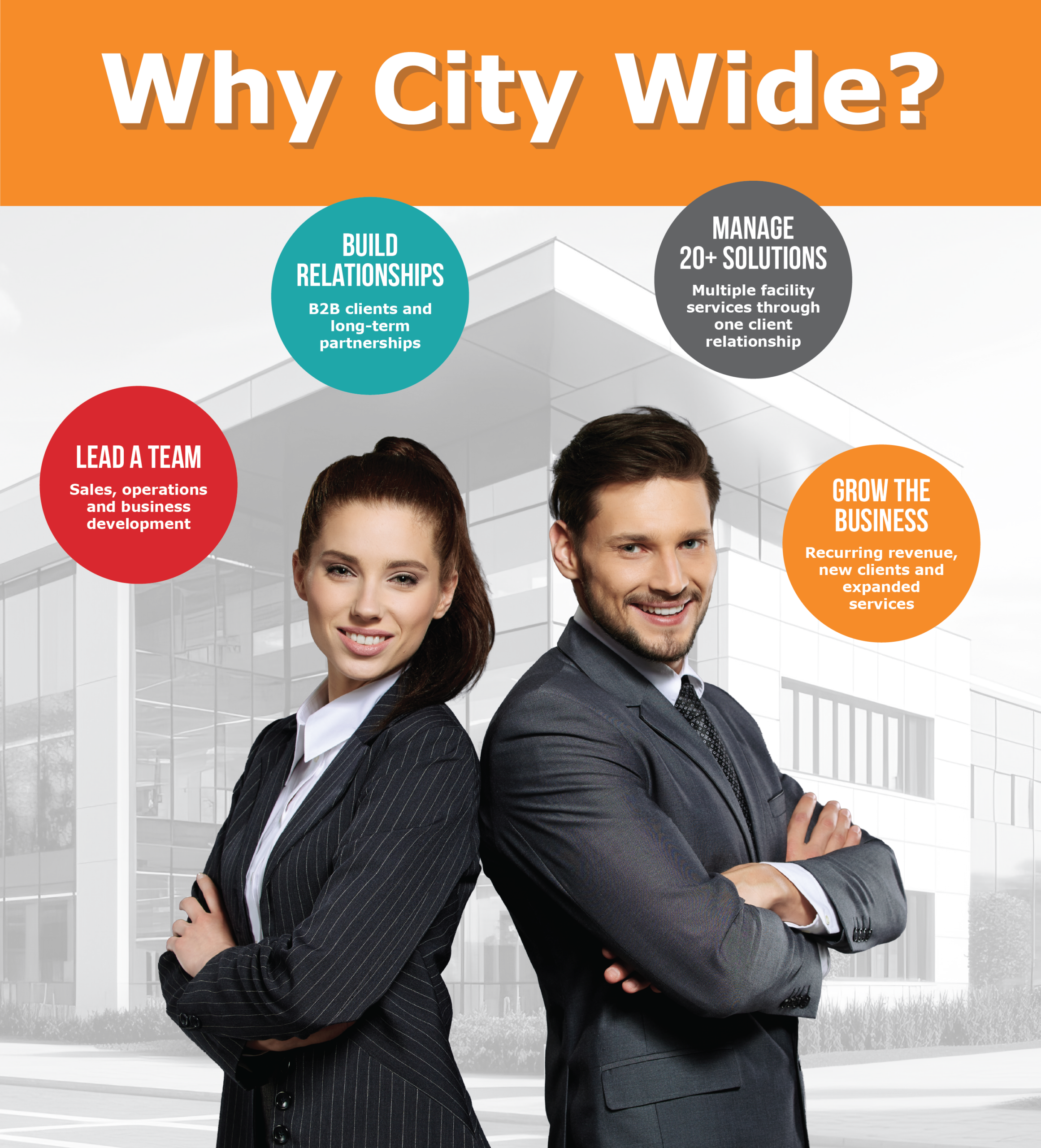
That B2B focus shapes how the business operates. Success centers around building a sales pipeline, developing long-term client relationships, solving problems, and creating a strong local team.
For someone with a background in B2B sales, leadership, or business development, that structure often feels familiar.
And those relationships matter. Harvard Business Review reports that acquiring a new customer costs anywhere from five to 25 times more than retaining an existing one. The same article cites research showing that increasing customer retention by just 5% was associated with profit increases of 25% to 95%.
City Wide’s model puts those long-term client relationships at the center of the business.
Owners Focus on Building the Business, Not Performing the Services
One of the biggest differences in the City Wide model is the role of the franchise owner.
City Wide offers more than 20 interior and exterior facility solutions, but franchise owners are not buying a business where they personally clean buildings, repair parking lots, or handle every maintenance request.
Instead, City Wide works with independent service providers who bring the technical expertise, equipment, and teams needed to perform the work.
That leaves the franchise owner focused on building the business: developing new client relationships, growing a team, overseeing operations, and planning for what comes next.
The owner’s job is to lead the business, not perform every service the business provides.
One Client Relationship Opens the Door to Multiple Services
Commercial facilities rarely need just one service.
A client might start with janitorial services and later need floor care, landscaping, HVAC, parking lot services, window washing, or another facility solution.
City Wide serves as one point of contact for more than 20 facility solutions. Instead of building a business around one specific service, franchise owners develop relationships with clients and look for additional ways to support their facilities.
The business model supports two paths for growth: adding new clients and expanding relationships with existing ones.
It also gives City Wide owners a much broader service offering than a franchise built around a single specialty.
Recurring Revenue Is Built into the Model
Revenue structure is another important factor when comparing franchise opportunities.
Many facility services are ongoing needs rather than one-time purchases. Businesses need their buildings cleaned regularly. HVAC equipment needs ongoing maintenance. Floors, landscaping, parking lots, and other areas require continued attention.
That creates an opportunity for recurring revenue, income earned repeatedly on a predictable schedule.
City Wide franchise owners build a base of recurring client relationships while also providing additional project-based services.
Those relationships tend to last. According to City Wide’s 2026 Item 19 FDD data, client relationships last an average of eight years.
Instead of starting every month at zero, owners work to grow an existing book of business while continuing to add new clients and services.
The Model Is Designed to Scale
Some businesses grow by requiring more from the owner. More customers mean more appointments, more jobs, more time in the field, and longer hours.
City Wide takes a different approach.
Growth centers around building a team and developing systems that support a larger business. As the client base grows, franchise owners add sales professionals, operations support, and other team members to help manage that growth.
The numbers help put that scalability into perspective. Item 19 in the FDD shares City Wide’s 2025 average annual revenue for the franchise network is $9.8 million. The 14 locations in the top quartile averaged $24.35 million in gross sales during the 2025 fiscal year.
Those figures are not a guarantee of individual results, but they show what the model has supported across established City Wide locations.
The goal is not to create a job for the owner. It is to build an organization.
That distinction matters for candidates looking beyond the first few years of franchise ownership and thinking about the type of business they ultimately want to build.
Franchise Owners Have an Established System Behind Them
Starting an independent business often means creating everything from scratch: processes, technology, sales strategies, training, branding, and operational systems.
A franchise provides an established framework.
City Wide itself has been around since 1961 and began franchising its business model in 2001. Over that time, the organization has continued to build the training, technology, sales processes, operational resources, and support systems behind the franchise network.
Owners still make decisions, lead their teams, develop their local markets, and build client relationships. They simply aren’t starting with a blank page.
The Right Owner Matters
City Wide is not designed for someone looking for a passive investment or a hands-on service business.
The model is built around leadership.
Successful franchise owners need to feel comfortable developing business relationships, leading people, holding teams accountable, and following an established system. They also need the drive to build something over time rather than simply manage what already exists.
That is why evaluating a franchise opportunity should work both ways.
Candidates should ask whether they believe in the model, but they should also ask whether the role of the owner matches their experience, strengths, and goals.
A Different Approach to Franchise Ownership
What makes the City Wide model different is not one single feature.
It is the combination of a B2B model, recurring client relationships, more than 20 facility solutions, independent service providers, an owner focused on leadership rather than performing the work, and a structure designed for long-term growth.
For the right person, those pieces create an opportunity to build something much bigger than a one-person operation.
And when comparing franchise opportunities, one of the most important questions to ask is simple:
What do I actually want my role as an owner to look like?
For someone who wants to lead a team, build B2B relationships, and grow an organization, the answer might look a lot like City Wide.